Again. It happens almost daily, one electronic glitch or another. Sometimes the Zoom app won't open, sometimes it's my iPhone. I swipe upward, as instructed, to make a call . Instead of the home screen, a page filled with emoji pops up. I don't want them, don't use them, I am trying to make a simple phone call to tell a friend not to rush to get here by noon, as I won't be quite ready. But I can't. I turn off the phone, swipe again. My daughter told me to use a lighter touch. Someone else told me to make sure to swipe from the very bottom of the screen. I was doing that, surely. Still, I get only those of cartoon faces. I give up. Too late. My friend is probably on her way here.
My mobile phone is sleek and elegant, and it can do many things--tell me where I am, find the fastest way to get where I'm going when the freeways are crowded, locate restaurants and shops. I can get my e-mail messages on it, play music, check the balance on my bank account. Yet I can't make a simple phone call?
Of course, the mind doesn't work as well as it used to. It's not the cell phone that's having a problem, it's me. Just about every older person I know struggles with electronic devices that are supposed to make our lives easier. Still, couldn't the manufacturers have included a little booklet with instructions in that elegant box?
Like it or not, we are compelled to rely on these mobile phones now. My family insists I have mine, always, on my person so "in case anything happens" I can be reached. They scold me if I forget to take it when I step out of the house. If I don't answer, they worry. One of my daughters gave me a cord to which I'm to attach the thing and hang it around my neck. A leash.
By enabling me to be accessible at all times, that phone robs me of the right to be unreachable. I value that right, though it may have been rendered obsolete. The Lyft car I call knows where I am with no help from me. How? Thanks to all kinds of devices that are supposedly for our protection, we are under constant surveillance.
I used to retrieve my messages from an answering machine when I came home, by simply picking up the receiver and dialing. There was no sign-in code, no security code, no inquiries about my identity, no warnings about spam, no "unknown caller" to avoid. The phone stood on a little shelf in my living room. I paid my monthly bill. It didn't intrude into my life. I did not need to defend myself against it.
Perhaps the most insidious of the social impacts of the cell phone is this: It promotes a sense of urgency, a need to hurry and respond immediately. We have become addicted to speed and the cell phone feeds that addiction. "Pruning minutes and seconds and hundredths of seconds has become an obsession in all but a few segments of our society," historian of science James Gleick wrote in his 1999 book FASTER, the Acceleration of Just about Everything.
In athletic competitions, such as swimming, split-second timing beyond human perception is now possible and "the margins have become so fine that chance easily overcomes the talent that racers strive so hard to perfect.... And the finish line is monitored by filmless computer-enhanced digital cameras, splitting time with a precision beyond the reach of human senses," Gleick wrote.
The acceleration can be seen in communication, as well, in everyday speech and media. Baja California is Baja, although that makes no sense in Spanish, and I've even heard people refer to Mexico as Mex. "In the spirit of Olympic swimmers shaving their chest hair, television networks are ever so delicately shaving the 'blacks,' the punctuation marks between shows, when the screen fades momentarily to darkness."
If you find that talk on television seems to be faster than normal, you're not wrong. Studies showing that people can hear speech that is more rapid than the pace at which they speak have prompted the elimination of pauses for breath. Hearing, though, is not equivalent to comprehension.
The breathless pace of children's media exceeds the ability of young children to process emotions, a scholar in Norway has pointed out. Natalia Kucirkova, a professor of child education and development, wrote:. "To develop empathy," for example, "a child must notice that another person feels something different. That small act of crossing over takes time."
Many products are promoted as time-savers. Although these savings are often so minimal as being barely perceptible, it's the idea of time saving that sells them.
People are busy busy busy, often doing several things at once (multitasking) because there never is enough time. But where does all that time we are saving go? How much of it do we need to spend on tending of our time-saving devices? Program updates require us to keep learning new ways to use our phones and computers.That eats up time. And who counts the minutes, sometimes hours, we wait on hold for customer service? AI help lines all too often prove useless, they fail to answer your specific question. Despairing, we may call a more computer-literate friend or a pricey consultant. Through all that, we find ourselves stressed out, agitated, we need time to unwind. Self-help programs for doing that have proliferated on the internet.
To be sure, I'm no longer in the thick of things, so it's easy for me to say but for heaven's sake, we need to slow down!
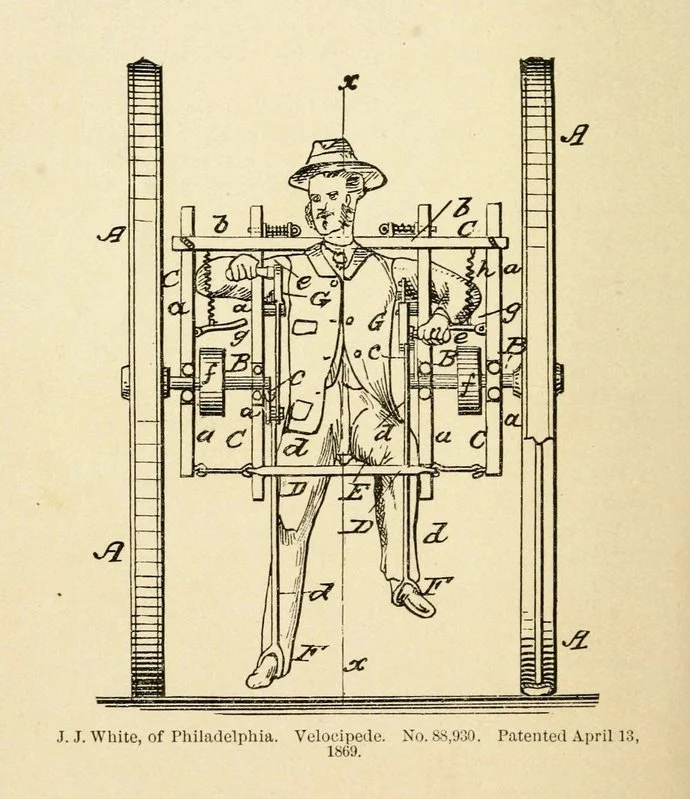
Caption: John J. White's new improved velocipede, which allows a rider to "walk with the vehicle", 1889
Credit: Public Domain Image Archive, Internet Archive, Boston Public Library